By implementing a policy to reduce the carbon footprint of our business travel, we contribute actively to the fight against climate change and show a commitment to sustainability.
We aim to reduce our greenhouse gas emissions to limit our impact and help protect our environment.
By rethinking modes of transportation
We are aware that all travel has an impact on the environment, so we are implementing different solutions:
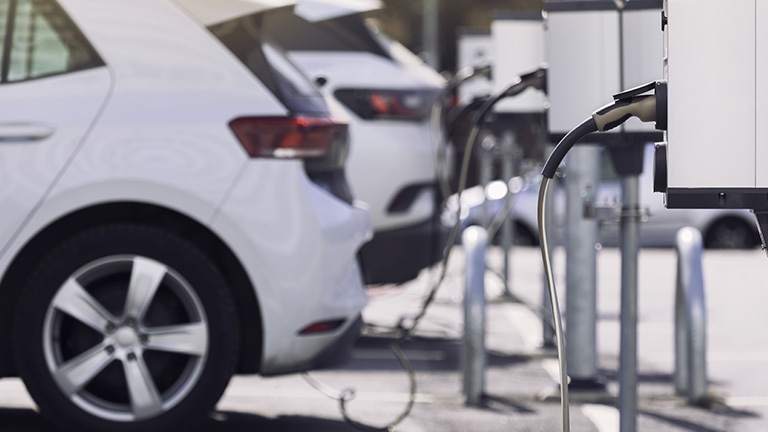
Switching to a fleet primarily composed of electric and hybrid vehicles
Assessing and tracking the carbon footprint of business travel
Promoting sustainable transportation solutions: public transportation, cycling, carpooling
Promoting home office to reduce commuting
Converting our vehicule fleets to electric
From 2022, we have a general policy of converting our service and company car fleets to electric or hybrid models.
25% of the Sixense fleet in France is electric or hybrid.
In Sixense UK we are reducing the carbon footprint of our business journeys by advocating the use of electric vehicles. Staff requiring a company vehicle for their role are given the option to request an EV rather than an ICE vehicle and we are strongly promoting the take-up of this option with currently 70% of our company car fleet now EV.
Richard Piggin
Managing Director - Sixense UK
PROMOTING carpooling and soft mobility
The calculation of our greenhouse gas emissions showed that of our three main sources of Scope 3 emissions (project equipment & materials, business travel, commuting), commuting accounted for approximately 34% of our emissions. We have, therefore, implemented several measures to reduce this carbon footprint, including the promotion of carpooling in France with the Klaxit application by BlaBlaCar Daily (at Sixense Engineering and Sixense Monitoring).
We also encourage the use of soft mobility such as cycling. To this end, we share best practices on cycling safety with our employees and, in certain offices in France, we provide them with bicycles to replace cars for certain short journeys, particularly for lunch.
Challenging ourselves systematically about our business trips
We ask our employees and managers to systematically ask themselves when they travel:
Can the meeting be held remotely?
Can a train be chosen over an airplane?
The aim, of course, is to arbitrate in favour of the solution with the lowest greenhouse gas emissions.